Depletion and Supplementation of Coenzyme Q10 in Secondary Deficiency Disorders.
Study Design
- Studientyp
- Review
- Population
- Patients with secondary CoQ10 deficiency
- Intervention
- Depletion and Supplementation of Coenzyme Q10 in Secondary Deficiency Disorders.
- Wirkungsrichtung
- Mixed
- Verzerrungsrisiko
- Unclear
Abstract
Coenzyme Q10 (CoQ10) deficiency is broadly divided into two types, primary and secondary. Primary CoQ10 deficiencies are relatively rare disorders resulting from mutations in genes directly involved in the CoQ10 biosynthetic pathway, and are not a subject of this article. Secondary CoQ10 disorders are relatively common, and may occur for a variety of reasons; these include mutations in genes not directly related to the synthetic pathway, oxidative stress induced reduction of CoQ10, and the effects of pharmacological agents such as statins. CoQ10 is of key importance in cell metabolism; in addition to its role in mitochondrial oxidative phosphorylation, it is a major endogenous antioxidant, and has a role in the metabolism of sulphides, lipids and amino acids. Given its importance in cell metabolism, it is unsurprising that secondary CoQ10 deficiency has been linked with a wide range of disorders. In this article, we have reviewed evidence of secondary CoQ10 deficiency in both common and less common disorders, and highlighted those disorders in which CoQ10 supplementation has been shown to be of significant clinical benefit.
Zusammenfassung
Evidence of secondary CoQ10 deficiency in both common and less common disorders is reviewed, and those disorders in which CoQ 10 supplementation has been shown to be of significant clinical benefit are highlighted.
Full Text
Depletion and Supplementation of Coenzyme Q10 in Secondary Deficiency Disorders
David Mantle1,†, Nadia Turton2,†, Iain P. Hargreaves2,*,†
1Pharma Nord (UK) Ltd, NE61 2DB Morpeth, UK 2School of Pharmacy and Biomolecular Sciences, Liverpool John Moores University, L3 3AF Liverpool, UK
*Correspondence: [email protected] (Iain P. Hargreaves) †These authors contributed equally.
Academic Editor: Graham Pawelec Submitted: 16 July 2022 Revised: 5 November 2022 Accepted: 2 December 2022 Published: 19 December 2022
Abstract
Coenzyme Q10 (CoQ10) deficiency is broadly divided into two types, primary and secondary. Primary CoQ10 deficiencies are relatively rare disorders resulting from mutations in genes directly involved in the CoQ10 biosynthetic pathway, and are not a subject of this article. Secondary CoQ10 disorders are relatively common, and may occur for a variety of reasons; these include mutations in genes not directly related to the synthetic pathway, oxidative stress induced reduction of CoQ10, and the effects of pharmacological agents such as statins. CoQ10 is of key importance in cell metabolism; in addition to its role in mitochondrial oxidative phosphorylation, it is a major endogenous antioxidant, and has a role in the metabolism of sulphides, lipids and amino acids. Given its importance in cell metabolism, it is unsurprising that secondary CoQ10 deficiency has been linked with a wide range of disorders. In this article, we have reviewed evidence of secondary CoQ10 deficiency in both common and less common disorders, and highlighted those disorders in which CoQ10 supplementation has been shown to be of significant clinical benefit.
Keywords: coenzyme Q10; ubiquinone; secondary deficiency; heart failure; kidney disease; diabetes; liver disease; neurological disorders; pulmonary disorders; periodontal disease
1. Introduction
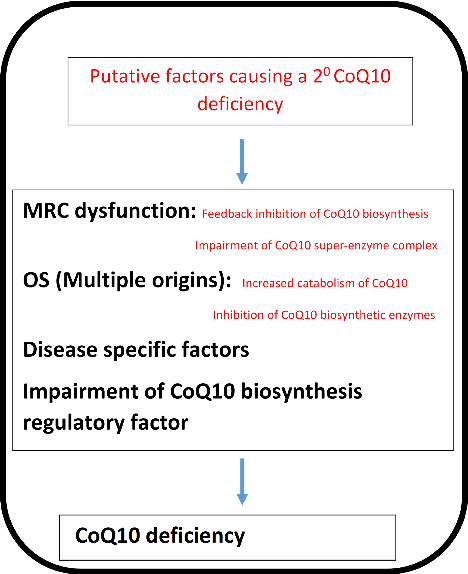
Coenzyme Q10 (CoQ10) is usually described as a vitamin-like substance, although it is endogenously synthesised within most cell types. CoQ10 has a number of functions of vital importance to normal cell function; these include (i) its key role in cellular energy supply/ATP synthesis via mitochondrial oxidative phosphorylation; (ii) its role as a major endogenously synthesised lipid soluble antioxidant, protecting cellular/subcellular organelle membranes from free radical induced oxidative damage; (iii) its role in the metabolism of lysosomes, sulphides, amino acids and cholesterol; (iv) its role as an anti-inflammatory agent [1,2]. Because of the multiplicity of roles in cell function, it is not surprising that deficiency of CoQ10 has been implicated in the pathogenesis of a wide range of disorders. CoQ10 deficiency is broadly divided into primary and secondary types [3]. Primary CoQ10 deficiency results from mutations in genes involved in the CoQ10 biosynthetic pathway. At least 10 genes are required for the biosynthesis of functional CoQ10, amutationinanyoneofwhich canresultinadeficit in CoQ10 status. Secondary coenzyme Q10 deficiency results from mutations in genes that are not directly related to the CoQ10 biosynthetic pathway, or to non-genetic factors associated with various disorders-examples of the latter category include increased oxidative stress and the use of statin type pharmaceuticals, as summarised in Fig. 1. In this article, we have reviewed both common and less common sec-
ondary disorders in which a deficiency of CoQ10 has been identified, and highlighted those disorders in which CoQ10 supplementation has been shown to be of significant benefit; the article is specifically concerned with clinical studies, and pre-clinical studies in animal models of disease have in general not been reviewed.
2. CoQ10 Deficiency/Supplementation in Common Disorders
In this section of the article, we have reviewed organs/systems in which secondary deficiency of CoQ10 has been reported, including the heart, kidneys, liver and central nervous system (CNS).
2.1 Heart Failure
The most well-known example of a secondary CoQ10 deficiency disorder is heart failure. By definition, heart failure is a condition in which the heart is unable to maintain circulation of the blood sufficiently to supply the requirements of the body. Heart failure can be considered to be a condition of myocardial energy starvation, characterised by mitochondrial dysfunction, reduced ATP production, increased free radical generation/oxidative stress, and inflammation [4]. Depletion of both circulatory and cardiac tissue levels of CoQ10 have been reported. Plasma levels of CoQ10 in healthy subjects have been reported to be in the range of 0.8–1.2 µg/mL, with plasma levels in
Copyright: © 2022 The Author(s). Published by IMR Press. This is an open access article under the CC BY 4.0 license.
Publisher’s Note: IMR Press stays neutral with regard to jurisdictional claims in published maps and institutional affiliations.
heart failure patients being significantly lower; Molyneux et al. [4] reported an independent association between reduced plasma CoQ10 levels and increased risk of mortality in patients with chronic heart failure. The association with increased mortality risk was stronger for CoQ10 than for the N-terminal pro-brain natriuretic peptide (NT-proBNP); the study was unable to confirm an association between increased mortality risk and plasma cholesterol levels. With regards to CoQ10 deficiency in cardiac tissue, endomyocardial biopsies from heart failure patients showed significantly decreasing levels of CoQ10 with increasing severity of symptoms as follows: New York Heart Association (NYHA) class I, 0.40 ± 0.06 µg/mg tissue dry weight; NYHA class II, 0.34 ± 0.06 µg/mg tissue dry weight; NYHA Class III or IV individuals, 0.28 ± 0.04 µg/mg tissue dry weight [5]. Supplementation with CoQ10 has been shown to restore both myocardial and circulatory CoQ10 to normal levels, with a concomitant improvement in clinical status. The best example of the beneficial effect of supplementary CoQ10 in heart failure is provided by the QSYMBIO randomised controlled clinical trial [6]. Patients with NYHA class III or IV heart failure were given supplemental CoQ10 (3 × 100 mg/day for two years), in addition to conventional heart failure medication. Supplementation with CoQ10 significantly reduced the relative risk of both cardiac related deaths (43%) and all-cause mortality (42%). There was no significant difference in adverse events be-
tween the CoQ10-treated and placebo groups over the duration of the study. Sub-group analysis of the effect of CoQ10 supplementation in the European cohort (231 of 420 patients) of the Q-SYMBIO study has been reported [7]. In these patients, the relative risk of major adverse cardiovascular events (MACE) was reduced by 67%, cardiac-related mortality by 53% and all-cause mortality by 55%; in addition, left ventricular ejection fraction was significantly improved by 6%, which was not observed in the original study, although NT-proBNP levels were not significantly altered. The improved outcome in the European cohort probably results from better patient compliance (in taking the required supplementation) with supplementing CoQ10, resulting in a consistently higher plasma CoQ10 level for the duration of the study.
- 2.2 Chronic Kidney Disease
- 2.3 Non-Alcoholic Fatty Liver Disease
- 2.4 Type II Diabetes
Several studies have reported significantly reduced blood CoQ10 levels in type II diabetic patients, correlating with increased levels of plasma glucose, HbA1C and markers of oxidative stress. Kolahdouz Mohammadi et al. [10] reported that CoQ10 supplementation (200 mg/day for three months) significantly reduced HbA1c levels in type II
diabetics. Similarly, Zahedi et al. [11] found that CoQ10 supplementation (150 mg/day for three months) significantly improved fasting plasma glucose and HbA1C levels, and Hosseinzadeh-Attar et al. [12] reported a significant improvement in HbA1c levels following supplementation with 200 mg/day for three months. The benefit of CoQ10 supplementation on glycaemic control and blood lipid levels has been confirmed in a recent meta-analysis by Zhang et al. [13].
- 2.5 Neurological Disorders
In Parkinson’s disease (PD), a deficiency in cerebral CoQ10 status has been reported; a decrease in CoQ10 status has also been reported in both the plasma and platelets of PD patients [14]. In a phase II clinical trial conducted by Shults et al. [15], oral CoQ10 supplementation (300–1200 mg/day) was found to reduce the functional decline of patients with early-stage PD. A subsequent phase III clinical trial involving six hundred patients was undertaken with PD patients receiving CoQ10 dosages of 1200 or 2400 mg/d [16]. Despite 1200 mg/d being the highest dosage used in the previous study, the mean change in Unified Parkinson’s Disease Rating Scale (UPDRS) score of treated patients was not found to be significantly lower than that of the placebo group; the researchers concluded that since CoQ10 appeared to show no apparent clinical benefit, they could not recommend its use in the treatment of early-stage PD. The contrasting findings of the clinical studies by Shults et al. [15] and Beal et al. [16] may reflect the broad range of sporadic PD patients used in the two clinical trials, with the heterogeneous patient populations contributing to their contradictory findings. Furthermore, no assessment of an underlying CoQ10 deficiency was determined in the PD patients prior to commencing CoQ10 supplementation in the study by Beal et al. [16], which may explain the limited therapeutic potential of CoQ10 reported. In multiple sclerosis, supplementation of patients with CoQ10 (500 mg/day for 3 months) reduced blood biomarkers of oxidative stress (malondialdehyde, total antioxidant capacity), reduced proinflammatory cytokine levels (IL-6, TNF alpha), and improved levels of fatigue [17–19].
- 2.6 Neuromuscular Disorders
Fibromyalgia patients have been shown to have depleted tissue levels (typically 40–50% of normal) of CoQ10, together with increased levels of mitochondrial dysfunction, oxidative stress and inflammation, both in adults and juveniles [20,21]. A randomised controlled clinical study by Cordero et al. [20] in 20 fibromyalgia patients found supplementation with CoQ10 (Pharma Nord BioQuinone, 300 mg/day for 40 days) significantly reduced (by more than 50%) pain and fatigue; there was a corresponding improvement in mitochondrial energy generation (via increased mitochondrial biogenesis), and reduced oxidative stress and inflammation. In this study, psychopathological symptoms (including depression) were also signif-
icantly improved; this was linked to the effect of supplemental CoQ10 in reducing oxidative stress and inflammation, as well as increased levels of serotonin [22,23]. In addition, Cordero et al. [24] correlated headache symptoms with reduced CoQ10 levels and increased oxidative stress in fibromyalgia patients, with headache symptoms and oxidative stress levels significantly improved following CoQ10 supplementation (300 mg/day for 3 months). Finally, in juvenile fibromyalgia patients, Miyamae et al. [21] reported coQ10 supplementation (100 mg/day for 3 months) significantly improved fatigue.
- 2.7 Sensory Disorders
- 2.8 Pulmonary Disorders
The potential benefit of CoQ10 supplementation has been investigated in a number of pulmonary disorders, including chronic obstructive pulmonary disease (COPD), COVID, influenza and asthma. There is evidence for mitochondrial dysfunction, oxidative stress and inflammation in the pathogenesis of COPD, indicating a potential therapeutic role for supplementation with CoQ10 [28]. Blood levels of CoQ10 are reportedly decreased in COPD patients [29]. There have been two randomised controlled trials supplementing CoQ10 in COPD, using doses of 50 mg/day for 8 weeks [30] and 180 mg/day for 8 weeks [31] respectively; both showed a significant improvement in respiratory function (as assessed via spirometry) following CoQ10 supplementation. Mitochondrial dysfunction has been implicated in the mechanism of COVID-19 infection [32]. In patients with COVID-19, blood platelet mitochondrial function and CoQ10 levels were significantly reduced [33]. The potential role of supplemental CoQ10 in the management of COVID-19 patients has been reviewed by Hargreaves & Mantle [34]. In patients with influenza, blood CoQ10 levels are reportedly reduced in both seasonal and pandemic (H1N1) forms [35,36], although to date there have been no randomised controlled trials supplementing CoQ10 in influenza. Asthma is a disorder characterised by increased oxidative stress and inflammation of the airways. Blood levels of CoQ10 are reduced in asthma patients [37]. Supplementation with CoQ10 (100 mg/day for 4 weeks) improved airflow in asthmatic patients [38].
- 2.9 Cancer
- 2.10 Reproductive Disorders
- 2.11 Endocrine Disorders
- 2.12 Gastrointestinal Disorders
In a randomised controlled clinical trial, supplementation with CoQ10 (200 mg/day for 8 weeks) significantly reduced levels of inflammatory markers and disease severity, and improved quality of life in patients with mild to moderate ulcerative colitis [62,63]. There are no studies listed on Medline relating to CoQ10 and Crohn’s disease, celiac disease, irritable bowel syndrome or gastric reflux.
- 2.13 Arthritis
- 2.14 Periodontal Disease
Periodontitis is a chronic condition in which degeneration of the supporting periodontal tissues (gingiva, periodontal ligaments, alveolar bone) ultimately results in tooth loss [66]. The initial cause of this condition is infection by various types of pathogenic Gram negative anaerobic bacteria, including Fusobacterium, Bacteroides, Porphyromonas and Prevotella species [67]. The formation of the resulting bacterial biofilm (plaque) on teeth initiates an immune response in the host, involving both the innate and adaptive immune systems [68]. Whilst some damage to the periodontal tissues results from the direct destructive action of these bacteria (via release of proteolytic enzymes), the majority of tissue damage results from over activation of the host immune system, resulting in a self-reinforcing cycle of inflammation, mitochondrial dysfunction and free radical induced oxidative stress [69]. CoQ10 is of potential relevance to periodontal disease, since it has potent antibacterial, antioxidant and anti-inflammatory action.
Several studies have provided evidence for a deficiency in coenzyme Q10 status in patients with periodontal disease. Thus a deficiency of CoQ10 in gingival biopsies of diseased tissue was identified, compared to biopsies taken from non-diseased areas in the same patients [70
72]. Similarly, Hansen et al. [73] found significant gingival and leukocytic deficiencies (typically 20%–60%) of coenzyme Q10 in patients with periodontal disease. In earlier supplementation studies, systemic or topical application of coenzyme Q10 in randomized placebo controlled clinical trials reported significant improvement in clinical status (e.g., pocket depth, gingival crevicular fluid flow, plaque scores) in patients with periodontal disease [74,75]. Despite these findings, the use of supplemental CoQ10 for the treatment of periodontal disease was questioned by Watts [76].
However, a number of more recent studies have provided evidence that topical application of CoQ10 (Perio Q10 gel ® containing 10% CoQ10 in a vegetable oil base, 2 mL for 3 months) as an adjunct to scaling and root planing results in a significant improvement in periodontal disease status compared to scaling and root planning alone. In a randomised controlled trial comprising 40 patients who
were smokers, topical application of CoQ10 resulted in a significant improvement in plaque index, pocket probing depth, sulcular bleeding index and clinical attachment level over a 3-month period, compared to scaling and root planning alone [77]. It is of note that smokers often respond more poorly to conventional periodontal treatment, since cigarette smoke is itself a potent source of free radicals. Similarly, a study by Shaheen et al. [78] reported topical application of CoQ10 resulted in a significant improvement in periodontal parameters compared to scaling and root planing alone. In contrast, in a study of 16 patients with periodontitis, topical application of CoQ10 significantly increased crevicular antioxidant status (quantified as superoxide dismutase), but did not significantly affect periodontal parameters (pocket depth, plaque index, gingival index) compared to scaling and root planing alone [79].
3. CoQ10 Deficiency/Supplementation inLess Common Disorders
- 3.1 Multiple System Atrophy
Multiple system atrophy (MSA) is an example of one of the less common neurological disorders. MSA results from progressive degeneration of neurons and glia, with subsequent dysfunction of the autonomic nervous system. The pathogenesis of MSA has been linked to the dysfunction of an enzyme (COQ2; 4-parahydroxybenzoate: polyphenyl- transferase) in the CoQ10 synthetic pathway [80]. Several studies have reported a reduction in plasma or post-mortem brain tissue. Thus, in a series of 44 MSA patients, Mitsui et al. [81] found a significant reduction in the mean plasma CoQ10 level of approximately 30% compared to controls. Barca et al. [82] found CoQ10 levels to be significantly depleted (by 40%) in post-mortem cerebellar tissue from MSA patients, compared to controls. In addition, in a study using induced pluripotent stem cell (iPSC)derived neurons, CoQ10 levels were significantly reduced in MSA patients, particularly those with COQ2 functional variants [83]. To date, there have been no randomised controlled trials of CoQ10 in MSA.
- 3.2 Progressive Supranuclear Palsy
Progressive supranuclear palsy (PSP) is a disorder resulting from tau protein aggregation in brain tissue, causing problems with balance, movement and vision. To date there have been two randomised controlled trials of supplementary CoQ10 in PSP. In the study by Stamelou et al. [84] of 20 PSP patients, supplementation with 5 mg/kg/day CoQ10 for 6 weeks resulted in improved cerebral energy metabolism assessed via magnetic resonance spectroscopy,
- as well as an improvement in PSP rating scale. In the study by Apetauerova et al. [85] of 60 PSP patients, supplementation with 2400 mg/day CoQ10 for up to 12 months did not significantly improve PSP symptoms or disease progression; however, the study had a high patient drop-out rate and lacked the precision to exclude a moderate benefit of CoQ10.
- 3.3 Ataxia
- 3.4 Lysosomal Storage Disorders
- 5) of the lumen of the organelle [89]. Proton translocation into the lumen is linked to the activity of a tentative respiratory chain (RC), where CoQ10 is believed to act as both an electron carrier and proton translocator [89]. The of the lumen is essential for the activity of lysosomal enzymes, such as those affected in San Filippo disease or mucopolysaccharidosis III (MPS III) [90]. MPS III is an autosomal recessive disorder caused by a mutation the genes encoding the enzymes required for the lysosomal degradation of heparin sulphate [91]. MPS III is characterized by childhood onset of speech delay, behavioural problems, progressive cognitive decline, loss of motor skills and epilepsy. A study by Delgadilloetal. [92]assessedtheplasmaCoQ10levelin30
patients with a range of mucopolysaccharidosis disorders, including 19 with MPS III and found evidence of a CoQ10 deficiency in the majority of the MPS III patients. A subsequent study by Yubero et al. [93] which assessed the nutritional status of 9 of the original 19 patients from the former study confirmed evidence of a plasma CoQ10 deficiency in 8 out of the 9 patients, together with an associated loss of circulatory pyridoxal phosphate (PLP, the active form of vitamin B6). Importantly, PLP is required for initial transamination of tyrosine into 4-hydroxyphenylpyruvic acid in the CoQ10 biosynthetic pathway, and a study by Willis et al. [94] has indicated a strong correlation between blood CoQ10 and vitamin B6 levels. Therefore, the lowered circulatory level of PLP may have contributed to the plasma CoQ10 deficiency detected in the MSP III patients. Furthermore, the decreased circulatory levels of CoQ10 in MPS III patients may be associated with malabsorption of CoQ10 from the gut, due to increased submucosal thickening or diarrhea, both of which are commonly associated with MPS III. In view of the possible involvement of oxidative stress in the pathogenesis of MSP III, increased reactive oxygen species (ROS) induced consumption of CoQ10may also be a contributory factor to the lowered circulatory levels of CoQ10 [95]. Decreased fibroblast CoQ10 status has also been reported in patients with MPS III, although cellular CoQ10 biosynthesis appeared to be unimpaired [96]. This latter result is supported by the normal levels of circulatory cholesterol reported in MPS III patients which indicates a functioning mevalonate pathway, a biosynthetic pathway shared by both CoQ10 and cholesterol, and therefore the deficit in CoQ10 status reported in this disorder may be an example of secondary CoQ10 deficiency. A recent study by Montero et al. [97] has reported evidence of plasma CoQ10 deficiency in a range of MPS patients including MSP III. The mechanism proposed to account for this diminution in circulatory CoQ10 levels was the possibility that heparan sulphate or mucopolysaccharides may create adducts with PLP, leading to a loss of vitamin B6 and consequently low CoQ concentrations. Interestingly, CoQ10 treatment was found to increase the residual activity of the defective enzyme in MPS III patient fibroblasts indicating some possible therapeutic potential for CoQ10 in the treatment of this disorder [90].
Evidence of a CoQ10 deficiency has also been reported in the lysosomal storage disorder Niemann Pick disease Type C (NPC), which is a neurodegenerative disease characterised by impaired intracellular cholesterol and lipid trafficking [98]. The preponderance of cases of NPC are caused by mutations in the genes encoding for the transmembrane lysosomal proteins NPC1 and NPC2. Although the exact mechanisms of disease pathophysiology have yet to be elucidated, defective NPC1 and NPC2 proteins result in the accumulation of intracellular un-esterified cholesterol and glycosphingolipids in the liver, brain and spleen of patients [98]. Decreased CoQ10 status and biosyn-
thetic capacity has been reported in fibroblasts from patients with NPC. The aberrant CoQ10 synthetic capacity in this disorder has been suggested to result from the accumulation in cholesterol which may down regulate β-Hydroxy β-methylglutaryl-CoA (HMG-CoA) reductase activity, the rate limiting enzyme in CoQ10 biosynthesis, resulting in a decrease in CoQ10 biosynthesis [99]. A study by Fu et al. [100] assessed the serum CoQ10 status in 37 patients with NPC and found evidence of a CoQ10 deficiency in only 4 patients, suggesting that the deficit in CoQ10 status may not be a consistent finding in NPC. However, 22 of the 37 NPC patients were found to have decreased levels of serum total antioxidant capacity compared to the controls, indicating the possibility that oxidative stress may be a factor to consider in the pathophysiology of this disorder.
- 3.5 Prader-Willi Syndrome
- 3.6 Leigh’s Syndrome
Leigh’s syndrome is a neurodegenerative disorder manifesting in early childhood, resulting in genetic defects affecting the process of oxidative phosphorylation; these can include dysfunction in the metabolism of pyruvate dehydrogenase or coenzyme Q10. Chen et al. [105] described the successful treatment of a child with Leigh’s syndrmoe resulting from the m.10197 G>A mutation. Martinelli et al. [106], Enns et al. [107] and Kouga et al. [108] described improvements in a Leigh’s syndrome patients following treatment with EPI 743 (100 mg/day for 12 weeks),
an analogue of CoQ10. Haginoya et al. [109] reported improved respiratory function in a Leigh’s syndrome patient following supplementation with the CoQ10 analogue, idebenone [110].
- 3.7 Kearns-Sayre Syndrome
- 3.8 Down Syndrome
- 3.9 Duchenne Muscular Dystrophy
Duchenne muscular dystrophy (DMD) is an X-linked genetic disorder (resulting in the absence of dystrophin protein) manifesting in male children, characterised by progressive wasting of skeletal muscles, with death in the late teens/early twenties following involvement of the respiratory and cardiac musculature. The blood levels of CoQ10 were significantly reduced in DMD patients, in common with other forms of muscular dystrophy [117]. Several randomised controlled clinical studies have reported a significant improvement in respiratory function in DMD patients following supplementation (900 mg/day for up to 6 years) with idebenone [118].
4. Discussion
As noted in the introduction to this article, secondary CoQ10 deficiencies can result from a variety of causes, which typically may reduce CoQ10 synthesis or increase its catabolism, as summarized in Fig. 1. In view of the central role of CoQ10 in cellular metabolism, it is unsurprising that a deficiency in endogenous CoQ10 status may be associated with a wide range of clinical presentations. In the present article we have identified a wide range of such disorders,
both common and uncommon, in which secondary CoQ10 deficiencieshavebeenreported. Whether such CoQ10 deficiencies occur as a cause or consequence of these disorders has still to be fully elucidated. However, not withstanding cause or consequence, the important issue is whether supplementation with CoQ10 can result in significant symptomatic benefit; this is particularly the case for those disorders for which conventional therapies are ineffective, or not available at all. We have therefore reviewed a similar range of disorders in which secondary CoQ10 deficiency has been corrected following oral CoQ10 supplementation, resulting in a significant improvement in clinical status, as validated in randomised controlled clinical trials.
The best documented secondary CoQ10 deficiency disorder in which CoQ10 supplementation has been shown to provide significant patient benefit is heart failure. There have been some 30 randomised controlled trials supplementing CoQ10 in heart failure, almost all of which have reported significant patient benefit [119]. The efficacy and safety of supplemental CoQ10 for treatment of heart failure have been confirmed by meta-analysis [120,121]. Heart failure may develop as a complication of other disorders; patients with type II diabetes, non-alcoholic fatty liver disease (NAFLD) and CKD are at increased risk of developing heart failure. Supplementation with CoQ10 in patients with these disorders may therefore help to prevent heart failure; in addition, there is evidence from randomised controlled trialsthatsupplementaryCoQ10canimprovebloodglucose control, liver and renal function in these disorders respectively, as noted in the relevant sections of this article.
Supplementationwith CoQ10has not been universally successful in all secondary CoQ10 deficiency disorders; the lack of benefit in some randomised controlled trials may result from a number of factors, including bioavailability, dosage of CoQ10, duration of therapy, patient selection, and unknown factors in CoQ10 metabolism may influence the efficiency of this treatment.
Supplemented CoQ10 is absorbed in the small intestine where it is fully reduced into its ubiquinol form in enterocytes before entry into the lymphatic system and release into the circulation [122]. Bioavailability is a particular problem; the bioavailability of CoQ10 is low, typically of the order of 5% at best [122]. Bioavailability is highly dependent on supplement formulation, in particular the degree of CoQ10 crystal dispersion as demonstrated in the study by Lopez-Lluch et al. [123]. Despite its limitations, there is presently no alternative method of administering CoQ10; whilst intravenous administration of CoQ10 has been described in animal models of disease, there have been no randomised controlled trials using this administration method to date. Supplementation of CoQ10 in neurological disorders such as PD has been particularly disappointing; this in turn may result from a lack of knowledge of some aspects of CoQ10 metabolism, for example whether CoQ10 can cross the blood-brain barrier in man, and how CoQ10 is subse-
quentlytransportedbetweenandwithinbraincells[14]. For some of the less common disorders described in this review, current treatments may lack efficacy, so patient benefit following CoQ10 supplementation is of potential importance, and worthy of further clinical investigations. Furthermore,
- at present there is no consensus on dosage or circulatory level of CoQ10 which may be of therapeutic value in the treatment of disease.
The assessment of CoQ10 status is well established in specialist laboratories [124]. In general, clinical assessment is based on serum/plasma determinations, with an established reference interval ranging from 0.5 to 1.7 uM. The actual reference range can vary between laboratories depending on the precise method of analysis employed. Generally, high performance liquid chromatography (HPLC) with either ultra violet (UV; at 275 nm) or electrochemical detection is used, although mass spectrographic (M) analysis is becoming more readily accessible. On the basis of the data provided in this review, we suggest that the measurement of endogenous CoQ10 status should become more of a routine assay in hospital clinical biochemistry laboratories, and that supplemental CoQ10 should be more widely utilised in clinical practice than is currently the case.
Ethics Approval and Consent to Participate
Not applicable.
Figures
Used In Evidence Reviews
Similar Papers
European journal of clinical nutrition · 1999
Coenzyme Q10 in health and disease.
Circulation. Heart failure · 2016
Coenzyme Q10 and Heart Failure: A State-of-the-Art Review.
Methodist DeBakey cardiovascular journal · 2019
Coenzyme Q10.
Nutrition journal · 2022
Effects of curcumin and/or coenzyme Q10 supplementation on metabolic control in subjects with metabolic syndrome: a randomized clinical trial.
European review for medical and pharmacological sciences · 2015
Omega-3 fatty acids and cardiovascular disease.
Current heart failure reports · 2016