Comparison of Coenzyme Q10 (Ubiquinone) and Reduced Coenzyme Q10 (Ubiquinol) as Supplement to Prevent Cardiovascular Disease and Reduce Cardiovascular Mortality.
Study Design
- अध्ययन प्रकार
- Review
- जनसंख्या
- Heart failure in clinical trials but did not distinguish between the o
- हस्तक्षेप
- Comparison of Coenzyme Q10 (Ubiquinone) and Reduced Coenzyme Q10 (Ubiquinol) as Supplement to Prevent Cardiovascular Disease and Reduce Cardiovascular Mortality.
- प्राथमिक परिणाम
- inflammation markers
- प्रभाव की दिशा
- Positive
- पूर्वाग्रह का जोखिम
- Unclear
Abstract
PURPOSE OF REVIEW: According to the World Health Organization (WHO), cardiovascular disease is the leading cause of death worldwide. Heart failure has been defined as a global pandemic leading to millions of deaths. Recent research clearly approved the beneficial effect of Coenzyme Q10 supplementation in treatment and prevention of cardiovascular disease in patients with heart failure in clinical trials but did not distinguish between the oxidised form CoQ10 and reduced form CoQH2 of Coenzyme Q10. The aim of this study is to determine differences in medical application of CoQ10 and CoQH2 supplementation and evaluate the efficacy of CoQ10 and CoQH2 supplementation to prevent cardiovascular disease in patients with heart failure. RECENT FINDINGS: A PubMed search for the terms "ubiquinone" and "ubiquinol" was conducted, and 28 clinical trials were included. Our findings go along with the biochemical description of CoQ10 and CoQH2, recording cardiovascular benefits for CoQ10 and antioxidative and anti-inflammatory properties for CoQH2. Our main outcomes are the following: (I) CoQ10 supplementation reduced cardiovascular death in patients with heart failure. This is not reported for CoQH2. (II) Test concentrations leading to cardiovascular benefits are much lower in CoQ10 studies than in CoQH2 studies. (III) Positive long-term effects reducing cardiovascular mortality are only observed in CoQ10 studies. Based on the existing literature, the authors recommend CoQ10 instead of CoQH2 to treat and prevent cardiovascular disease in patients with heart failure.
संक्षेप में
Differences in medical application of CoQ10 and CoQH2 supplementation are determined and the efficacy of CoQ10 and CoQH2 supplementation to prevent cardiovascular disease in patients with heart failure is evaluated.
Full Text
HEART FAILURE (HJ EISEN, SECTION EDITOR)
Comparison of Coenzyme Q10 (Ubiquinone) and Reduced Coenzyme Q10 (Ubiquinol) as Supplement to Prevent Cardiovascular Disease and Reduce Cardiovascular Mortality
Johannes‑Paul Fladerer1,2 · Selina Grollitsch1
Accepted: 31 October 2023 / Published online: 16 November 2023 © The Author(s) 2023
Abstract
Purpose of Review According to the World Health Organization (WHO), cardiovascular disease is the leading cause of death worldwide. Heart failure has been defined as a global pandemic leading to millions of deaths. Recent research clearly approved the beneficial effect of Coenzyme Q10 supplementation in treatment and prevention of cardiovascular disease in patients with heart failure in clinical trials but did not distinguish between the oxidised form CoQ10 and reduced form CoQH2 of Coenzyme Q10. The aim of this study is to determine differences in medical application of CoQ10 and CoQH2 supplementation and evaluate the efficacy of CoQ10 and CoQH2 supplementation to prevent cardiovascular disease in patients with heart failure.
Recent Findings A PubMed search for the terms “ubiquinone” and “ubiquinol” was conducted, and 28 clinical trials were included. Our findings go along with the biochemical description of CoQ10 and CoQH2, recording cardiovascular benefits for CoQ10 and antioxidative and anti-inflammatory properties for CoQH2. Our main outcomes are the following: (I) CoQ10 supplementation reduced cardiovascular death in patients with heart failure. This is not reported for CoQH2. (II) Test concentrations leading to cardiovascular benefits are much lower in CoQ10 studies than in CoQH2 studies. (III) Positive long-term effects reducing cardiovascular mortality are only observed in CoQ10 studies.
Summary Based on the existing literature, the authors recommend CoQ10 instead of CoQH2 to treat and prevent cardiovascular disease in patients with heart failure.
Keywords Coenzyme Q10 · Heart failure · Ubiquinone · Ubiquinol
Introduction
According to the World Health Organization (WHO), cardiovascular disease (CVD) is the leading cause of death worldwide [1]. Heart failure (HF) has been defined as a global pandemic leading to millions of deaths [2]. HF is described
- as clinical syndrome with symptoms and/or signs caused by a structural and/or functional cardiac abnormality and corroborated by elevated natriuretic peptide levels and/or objective evidence of pulmonary or systemic congestion [3].
* Johannes-Paul Fladerer [email protected]
- 1 Institute of Pharmaceutical Sciences, University of Graz, Beethovenstraße 8, 8010 Graz, Austria
- 2 Apomedica Pharmazeutische Produkte GmbH, Roseggerkai 3, 8010 Graz, Austria
During the last decades, Coenzyme Q10 has been established as adjunctive therapy for CVD and HF [4].
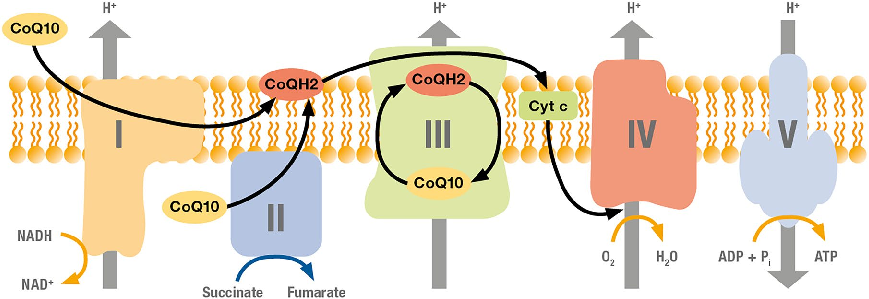
Coenzyme Q10 is a redox molecule occurring in the human body in 2 bioactive states, ubiquinone (CoQ10) as oxidised state and ubiquinol (CoQH2) as reduced state [5]. Both redox forms of Coenzyme Q10 are bioactive and important for human health [6]. CoQ10 is essential for cellular adenosine phosphate (ATP) energy production [7] as it shuttles electrons from complexes I and II to complex III of the mitochondrial respiratory chain (Fig. 1). CoQH2 is an important lipid-soluble antioxidant preventing peroxidation of the low-density lipoproteins in the blood circulation [8] with additional anti-inflammatory activity [9].
A slightly better water solubility and a lack of understanding absorption and transfer of CoQ10 and CoQH2 have led to misleading interpretations pushing CoQH2 as more bioactive form [10•]. Therefore, it is important to notice that (I) CoQH2 is very unstable [11] and under normal conditions oxidised to
Vol.:(0123456789)1 3
- Fig. 1 Function of CoQ10 in the mitochondrial respiratory chain. CoQ10 is an essential transfer molecule for complex I and complex II at the beginning of the respiratory chain
CoQ10 [12], (II) CoQH2 has to be oxidised to CoQ10 before it can be absorbed in enterocytes [6], (III) the bioavailability of CoQ10 and CoQH2 mainly depends on crystal dispersion status and carrier oil composition [13].
Interestingly, only CoQ10 is synthesised in the human body by way of the mevalonate pathway, an essential metabolic pathway including byproducts like cholesterol and other isoprenoids. And this shared dependence on the mevalonate pathway was the reason for focusing attention to CoQ10 in CVD [14].
Recent reviews clearly approved the beneficial effect of Coenzyme Q10 supplementation in treatment and prevention of CVD in clinical trials but did not distinguish between CoQ10 and CoQH2 supplementation [15]. As comparative clinical trials are missing and misleading marketing claims are revealed [10•], a critical view comparing the effectivity of supplementation with CoQ10 and CoQH2 in CVD therapies is needed.
Objectives
Our goal is to determine differences in medical application of CoQ10 and CoQH2 supplementation and evaluate the efficacy of CoQ10 and CoQH2 supplementation to prevent cardiovascular diseases. The final aim is to identify the most promising supplement to reduce cardiovascular mortality in patients with heart failure. We focused on the medical evidence that can be found in the literature.
Methods
Search Methods
We searched PubMed for the term “ubiquinone” and “ubiquinol” from 5 to 12th July 2023. We applied no
language restrictions. We used the filter “randomized controlled trial” and searched for results published between 1993 and 2023.
Selection Criteria
Only randomised, double blind, placebo-controlled, parallel or cross‐over trial has been included. Trials investigated the supplementation of CoQ10 or CoQH2 alone or with one other single supplement. We excluded any trials involving multifactorial lifestyle interventions to avoid confounding. Trials including children or lacking necessary information or comparability have been excluded from the evaluation of ubiquinone and ubiquinol supplementation to prevent cardiovascular diseases. We excluded studies with a daily CoQ10 or CoQH2 intake lower than 50 mg. Follow-up-studies with own objectives are treated as separate studies.
Types of Outcome Measures
To determine differences in medical application of CoQ10 and CoQH2 supplementation, we assigned the studies to the following applications: antioxidative activity, bronchial diseases, cancer, cardiovascular diseases, eye diseases, hepatic diseases, Huntington, infections, infertility, inflammation, mental health, metabolic syndrome, migraine, mitochondrial dysfunction, pain, Parkinson, physical health, polycystic ovary syndrome, pregnancy, presbycusis, statin associated pain, others.
In case of the evaluation of CoQ10 and CoQH2 as prevention of cardiovascular disease, we recorded reduced cardiovascular mortality, clinical status, echocardiography, 6-min walk test, NYHA, E/e´, EF, B-type natriuretic peptides (BNP) and hospitalisation.
We further compared the reduction of cardiovascular mortality in patients with heart failure as main result to identify the most promising supplement.
Data Collection and Analysis
Two authors independently selected trials for inclusion, abstracted data and assessed the risk of bias.
Results
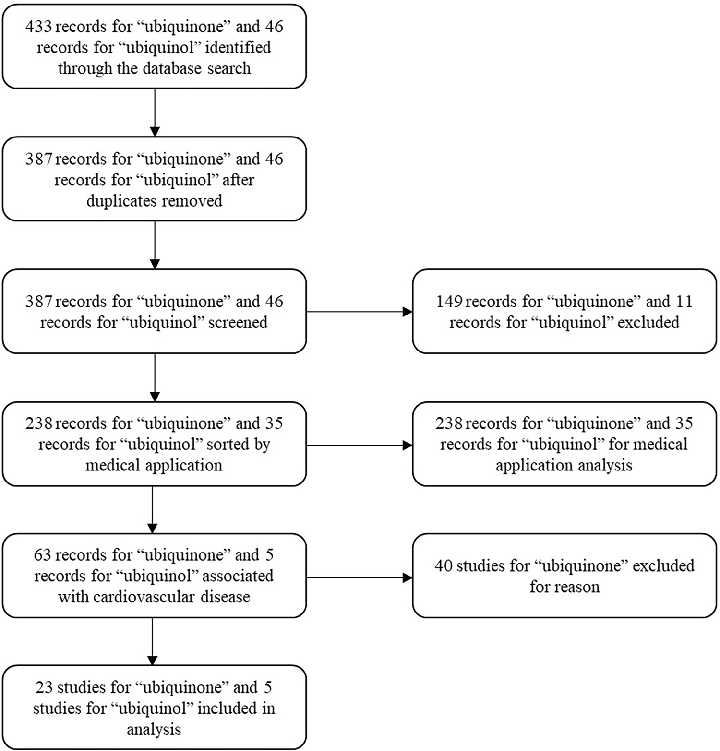
We identified 238 randomised controlled trials for ubiquinone and 35 for ubiquinol, which were sorted by medical application. Twenty-three studies of ubiquinone and 5 of ubiquinol were included to analyse their potential to prevent cardiovascular disease. These 28 studies were compared according to the ability of the given supplements to reduce cardiovascular mortality in patients with heart failure (Fig. 2).
Different Medical Applications of CoQ10 and CoQH2 Supplementation
We associated a total of 273 studies with 21 medical applications. Studies with unclear applications or with applications recorded only once are included in the group “Others”. According to the different study numbers of CoQ10 and CoQH2, relative results are presented in Fig. 3.
By comparison of applications, CoQ10 can be identified as promising agent to treat cardiovascular diseases while CoQH2 can be preferred for treatment of inflammation and antioxidative activity. These findings go along with the biochemical description of CoQ10 and CoQH2 [7, 8]. The different clinical evidence for the usage of CoQ10 and CoQH2 as supplement for cardiovascular disease is demonstrated in Fig. 4.
At this point, it should be mentioned that the enormous difference in the number of conducted studies (6.8-fold difference) suggests that CoQ10 is better investigated than CoQH2. The number of clinical trials for CoQH2 is limited [10•].
- Fig. 2 Study flow diagram
- Fig. 3 Comparison of CoQ10 and CoQH2 by application. Results are demonstrated as %. Cardiovascular diseases are marked in red
- Fig. 4 Comparison of CoQ10 and CoQH2. Given is the number of clinical trials associated with cardiovascular disease for both supplements
Effects of CoQ10 and CoQH2 on Cardiovascular Diseases
Results of 28 studies (23 original studies and 5 followup studies with specific aims) investigating the effects of CoQ10 and CoQH2 on cardiovascular diseases are demonstrated in Table 1. In the original studies, 3523 are included.
Summarising results of Table 1 leads to three major outcomes: (I) the number of studies investigating the effect of CoQH2 on cardiovascular diseases is very limited; (II) In contrast to CoQ10, no CoQH2 study could clearly demonstrate a reduced cardiovascular mortality; (III) the used concentrations are much higher in studies investigating CoQH2.
According to these results, we conclude that based on the medical data available, CoQ10 is the more promising supplement to prevent cardiovascular diseases and to treat patients with heart failure. Further arguments for CoQ10 are the additive effect in combination with selenium [30, 31••] and the reduction of adverse effects of statin therapy by supplementation with CoQ10 [44–46]. Additionally, in all clinical trials included in this study, patients proceeded with their previous medication (statins, antihypertensives and others) and no interactions between CoQ10 and medicines could be observed.
At this point, it should be noticed that the Q-SYMBIO [25••] and KISEL-10 studies [31••] and their follow-up studies, all working on CoQ10, are the only clinical investigations clearly demonstrating a reduction in cardiovascular mortality in patients with heart failure over many years. Some studies working on CoQH2 are citing Q-SYMBIO and KISEL-10 studies to prove the cardiovascular effect of CoQH2 despite the fact that these studies are working on CoQ10 instead of CoQH2 [42]. Such misleading investigations are in detail discussed by Judy and Mantle [6, 10•].
Discussion
Even 30 years ago, studies recorded the beneficial effect of CoQ10 supplementation alone or in combination with selenium to improve EF [16], reduce time of hospitalisation [17] and reduce cardiovascular mortality in patients with heart failure [30]. In contrast to that, clinical trial investigation on the effect of CoQH2 on patients with
Table 1 Effects of CoQ10 and CoQH2 on cardiovascular diseases. Empty cells are used if information is missing
Effect Reduced cardiovascular mortality (%)
Daily intake (mg/d)
Author Year Probands included
Duration supplementation/ (study) [weeks]
CoQ10 Judy et al. [16] 1993 20 6/(6) 100 Improved echocar-
diogram and improved EF
Morisco et al. [17] 1993 641 52/(52) 160 Reduced time of hospitalisation
Chello et al. [18] 1994 40 1/(1) 150 No reduced cardiovascular mortality
Morisco et al. [19] 1994 6 4/(8) 200 Improved echocardiogram Improved EF
Singh et al. [20] 1998 144 4/(4) 120 Reduced cardiovascular mortality
Berman et al. [21] 2004 32 12/(12) 60 Improved clinical status, improved 6-min walk test and improved NYHA class
Chew et al. [22] 2008 74 24/(24) 160 No improved E/e´ ratio
Makhija et al. [23] 2008 30 7/(7) 165 Reduced time of hospitalisation
Kuimov et al. [24] 2013 8/(8) 60 Improved clinical
status Mortensen et al.
2014 420 16/(104) 300 Improved NYHA class, reduced time of hospitalisation and reduced cardiovascular mortality
[25••]
Aslanabadi et al. [26] 2016 100 0.14/(0.14) 300 Reduced cardiovascular mortality
Mortensen et al. [27] 2019 231 12/(96) 300 Improved NYHA class, improved EF, reduced time of hospitalisation and reduced cardiovascular mortality
Sobirin et al. [28] 2019 28 4/(4) 300 Improved E/e´ ratio Khan et al. [29] 2020 123 0.14/(0.14) 400 Reduced BNPs and
reduced time of hospitalisation
CoQ10 & Selenium Kuklinski et al. [30] 1994 61 52/(52) 100 Reduced cardiovas-
cular mortality
Alehagen et al. [31••]
2013 443 260/(520) 200 Improved echocardiogram, improved EF, reduced BNPs and reduced cardiovascular mortality
- Alehagen et al. [32] 2015 443 260/(520) 200 Reduced cardiovascular mortality
- Alehagen et al. [33] 2015 443 148/(270) 200 Reduced cardiovascular mortality
- Alehagen et al. [34] 2016 668 208/(478.4) 200 Reduced cardiovascular mortality
0
15.90
18.00
2.00
11.00
20.00
6.70
8.00
Table 1 (continued)
Author Year Probands included
Duration supplementation/ (study) [weeks]
Daily intake (mg/d)
Effect Reduced cardiovascular mortality (%)
- Alehagen et al. [35] 2018 434 208/(832) 200 Reduced cardiovascular mortality
- Alehagen et al. [36] 2021 213 208/(254) 200 Reduced cardiovascular mortality
Opstad et al. [37] 2022 118 42/(520) 200 Reduced cardiovascular mortality
Alehagen et al. [38] 2022 443 148/(148) 200 Improved echocardiogram, improved EF, reduced BNPs and reduced cardiovascular mortality
CoQH2 Orlando et al. [39] 2020 50 2/(26) 400 Improved echocardiogram, improved EF, no reduced cardiovascular mortality
Kawashima et al. [40] 2020 14 12/(12) 400 No improved echocardiogram and improved endothelial function
Holmberg et al. [41] 2021 43 1/(1) 600 Improved EF and no reduced cardiovascular mortality
Samuel et al. [42] 2022 39 12/(12) 300 No Improved E/ e´ratio and no reduced BNPs
CoQH2 & Ribose Pierce et al. [43•] 2022 216 12/(12) 600 Improved clinical status, improved EF, reduced BNPs and no reduced cardiovascular mortality
10.00
6.00
6.70
0
0
0
heart failure started much later in 2020 [39] while investigations concerning antioxidant and anti-inflammatory activity of CoQH2 have been conducted in 1993 [47, 48]. This difference in medical evidence makes it challenging to compare CoQ10 and CoQH2 supplementation according to its usage to treat patients with cardiovascular disease and heart failure. Additionally, most CoQH2 studies used much higher concentrations than CoQ10 studies. CoQ10 studies included in this research test concentrations between 60 and 300 mg/day with one exception using 400 mg/day [29]. Studies with CoQ10 with selenium additive test between 100 and 200 mg/day. In contrast to that, CoQH2 studies included test concentrations between 300 and 600 mg/day. The only CoQH2 study using 300 mg/ day test concentration included only 39 patients, and no beneficial cardiovascular effects could be observed [42].
Taking a closer look at major studies including at least 200 patients reveal extreme differences between CoQ10 and CoQH2. The group of Morisco et al. [17] reported a significant reduction in hospitalisation time in a study including 641 patients with heart failure and CoQ10 supplementation of 160 mg/day. The most cited Q-SYMBIO study of Mortensen et al. [25••] included 420 patients with heart failure and applied 3 × 100 mg of CoQ10 per day. After 2 years, a significant reduced time of hospitalisation and an improved NYHA class could be recorded. And most important, the cardiovascular mortality decreased by 18% compared to placebo group. KISEL-10 studies [31••] included 443 patients and applied 200 mg of CoQ10 per day combined with 200 µg of selenium. These studies focused on long-term effects of CoQ10 on cardiovascular mortality in patients with heart failure. They recorded a decrease
of cardiovascular mortality of 17.9% after 10 years [32] and of 10.6% after 12 years [35]. In contrast to that, the CoQH2 study of Pierce et al. [43•] included 216 patients and applied 600 mg of CoQH2 per day in combination with 15 g/day of ribose. They recorded improved clinical status, improved EF and reduced BNPs values, but no reduction of cardiovascular mortality. According to the higher concentration (600 mg/day instead of 200 or 300 mg/day) used in CoQH2 studies and the weaker recorded benefit for patients with heart failure, the usage of CoQ10 supplementation is recommended in therapies of heart failure and cardiovascular disease in general.
Interestingly, there are differences in clinical outcomes of CoQ10 and CoQH2 despite the fact that CoQ10 can be converted to CoQH2 and vice versa in the human body by
- at least five enzymes [6]. Possible reasons are a different stomach transit [49] and duodenal absorption [50]. At this point, it should be stated that more pharmacological studies are needed to provide a clear answer to this question. Mantle et al. consider that many different cell types may have the capacity to reduce CoQ10 to CoQH2 in the external cellular environment. And if this is found to be the case, then presumably any of the various cell types lining the gastrointestinal tract would be able to facilitate this conversion, and the requirement for supplemental CoQH2 to maximise absorption would be negated [6]. Finally, it has to be noted that clear differences in clinical outcomes occur between CoQ10 and CoQH2.
Conclusion
Author Contributions All authors had full access to the data in the study and takes responsibility for the integrity of the data and the accuracy of the data analysis. Concept and study design as well as manuscript writing was performed by JPF. SG did the data preparation and conducted the table. All authors read and approved the manuscript.
Funding Open access funding provided by University of Graz. KarlFranzens-Universität Graz.
Data Availability Data and additional informations are available on request.
Compliance with Ethical Standards
Conflict of Interest JPF reported receiving personal fees from Apomedica Pharmazeutische Produkte GmbH as part-time employee. The authors declare no conflict of interest.
Human and Animal Rights and Informed Consent This article does not contain any studies with human or animal subjects performed by any of the authors.
Role of the Funder/Sponsor The funders had no role in the design of the study.
Open Access This article is licensed under a Creative Commons Attribution 4.0 International License, which permits use, sharing, adaptation, distribution and reproduction in any medium or format, as long as you give appropriate credit to the original author(s) and the source, provide a link to the Creative Commons licence, and indicate if changes were made. The images or other third party material in this article are included in the article’s Creative Commons licence, unless indicated otherwise in a credit line to the material. If material is not included in the article’s Creative Commons licence and your intended use is not permitted by statutory regulation or exceeds the permitted use, you will need to obtain permission directly from the copyright holder. To view a copy of this licence, visit http://creativecommons.org/licenses/by/4.0/.
As detailed above, our findings go along with the literature and the biochemical description of CoQ10 and CoQH2, recording cardiovascular benefits for CoQ10 and antioxidative and anti-inflammatory properties for CoQH2 [7, 8]. It has to be noted that there is a lack of clinical relevant trials and misleading marketing claims associating CoQH2 with cardiovascular benefits [10•]. Comparing the work of Morisco et al. [17] and Q-SYMBIO, KISEL-10 studies [25••, 31••] with the study of Pierce et al. [43•] lead to the following outcomes: (I) CoQ10 supplementation alone or in combination with selenium reduced cardiovascular death in patients with heart failure. This is not recorded for CoQH2.
- (II) Test concentrations leading to cardiovascular benefits are much lower in CoQ10 studies than in CoQH2 studies.
- (III) Positive long-term effects are only observed in CoQ10 studies. In these studies, reduced cardiovascular mortality is recorded even after 12 years. Based on the existing literature, the authors recommend CoQ10 instead of CoQH2 to treat and prevent cardiovascular disease in patients with heart failure.
Figures
Used In Evidence Reviews
Similar Papers
European journal of clinical nutrition · 1999
Coenzyme Q10 in health and disease.
Circulation. Heart failure · 2016
Coenzyme Q10 and Heart Failure: A State-of-the-Art Review.
Methodist DeBakey cardiovascular journal · 2019
Coenzyme Q10.
Nutrition journal · 2022
Effects of curcumin and/or coenzyme Q10 supplementation on metabolic control in subjects with metabolic syndrome: a randomized clinical trial.
European review for medical and pharmacological sciences · 2015
Omega-3 fatty acids and cardiovascular disease.
Current heart failure reports · 2016